
Table of Contents
Author Bio – Sandra Beale – Britain’s leading Toddler STEM expert
Sandra Beale is the Founder of Toddler and Early Years STEM, an Early Years STEM specialist and Britain’s leading Toddler STEM expert, known for creating hands‑on, sensory‑rich science activities for babies, toddlers, and early years. She is an award‑winning author and BBC STEM freelancer with more than 11 years’ experience delivering STEM workshops, CPD training, and playful science sessions across the UK.

Creating Large Bubbles
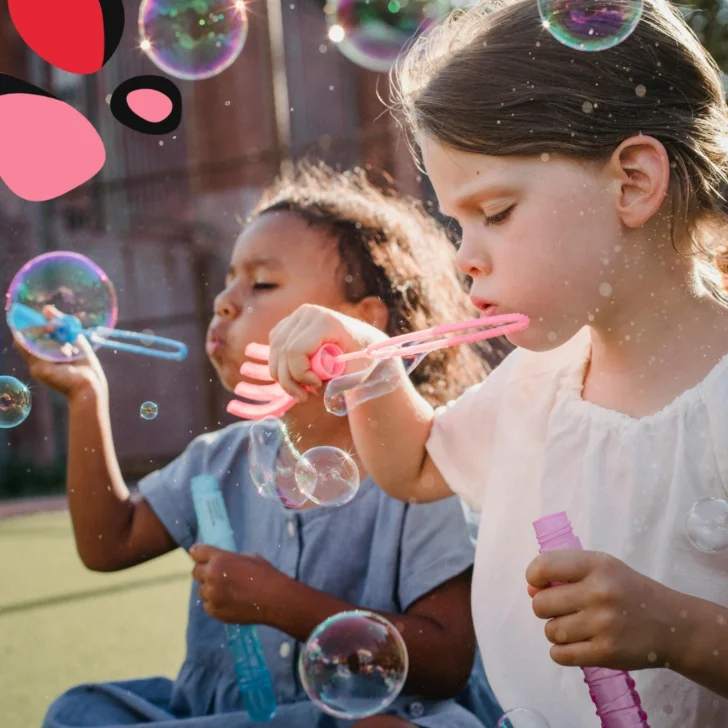
If you’re looking for a fun, joyful STEM activity to try over the Summer Holidays — whether in your Early Years setting or at home — creating large bubbles is a brilliant choice. It’s wonderfully messy, full of curiosity, and always a huge hit with the children in my Toddler and Early Years STEM sessions.
Invite your preschoolers or Key Stage 1 children to gather around the table. They can sit or stand — I always find that being flexible with seating makes the experience more relaxed and enjoyable for both children and their caregivers. When children feel comfortable, they’re far more open to exploring, experimenting, and asking questions.
Watch Sandra create the bubbles on You Tube
Materials Required
- Large Tray
- Washing up liquid
- Water
- Food colouring
- Balloon pump
Method
- Pour some water in the tray
- Squirt some food colouring in the water
- Squirt some washing up liquid in the water
- Ask the children to use the balloon pumps to pump air into the water
- Invite them to experiment with fast vs. slow pumping to compare bubble size
The Science
- Washing‑up liquid contains surfactants — tiny molecules that reduce the surface tension of water, making it stretchy enough to form bubble films.
- Water on its own can’t make strong bubbles because its molecules cling tightly together; the surfactants loosen this grip.
- When children pump air into the mixture, the air becomes trapped inside these flexible films, creating bubbles of different sizes.
- More force = bigger bubbles — pumping harder increases air pressure, inflating the bubble film further.
- Food colouring helps children see movement and mixing, supporting observation skills and early scientific noticing.
- Children explore cause and effect as they see how different pumping speeds change bubble size and how bubbles pop.
- This experiment introduces early chemistry and physics, including surface tension, air pressure, and material properties.
Taking it Forward
- Encourage children to experiment with different pumping speeds to see how bubble size changes, supporting early prediction and testing skills.
- Try adding different colours to explore colour mixing and visual changes in the bubble mixture.
- Let children compare tools (balloon pump, straws, spoons) to investigate how different methods create different bubbles.
More About Sandra Beale
Since 2020, Sandra’s work with young children has been recognised by HRH The Princess of Wales through ongoing correspondence, including a letter of congratulations on the launch of her book 50 Fantastic Ideas for STEM Activities (Bloomsbury, 2025), winner of the Creative Play Learning Resources Award (0–3). In June 2026, Sandra was invited to the House of Lords in recognition of her contribution to Early Years STEM learning and her advocacy for accessible, curiosity‑led science experiences.
Sandra also has a Toddler STEM YouTube channel sharing simple, developmentally appropriate STEM activities for under‑fives. She is a STEM contributor to Nursery World and Smalltalk, and her sessions have attracted national attention — including a visit from Kemi Badenoch MP in 2023, who attended one of her toddler STEM workshops.
She delivers engaging STEM sessions in schools, nurseries, libraries, and community settings, helping young children explore science through hands‑on investigation, sensory play, and early scientific thinking. Her work supports the EYFS, STEM in early childhood, and the national focus on early brain development and playful learning.